Dirty data: why your AI project will fail before it starts
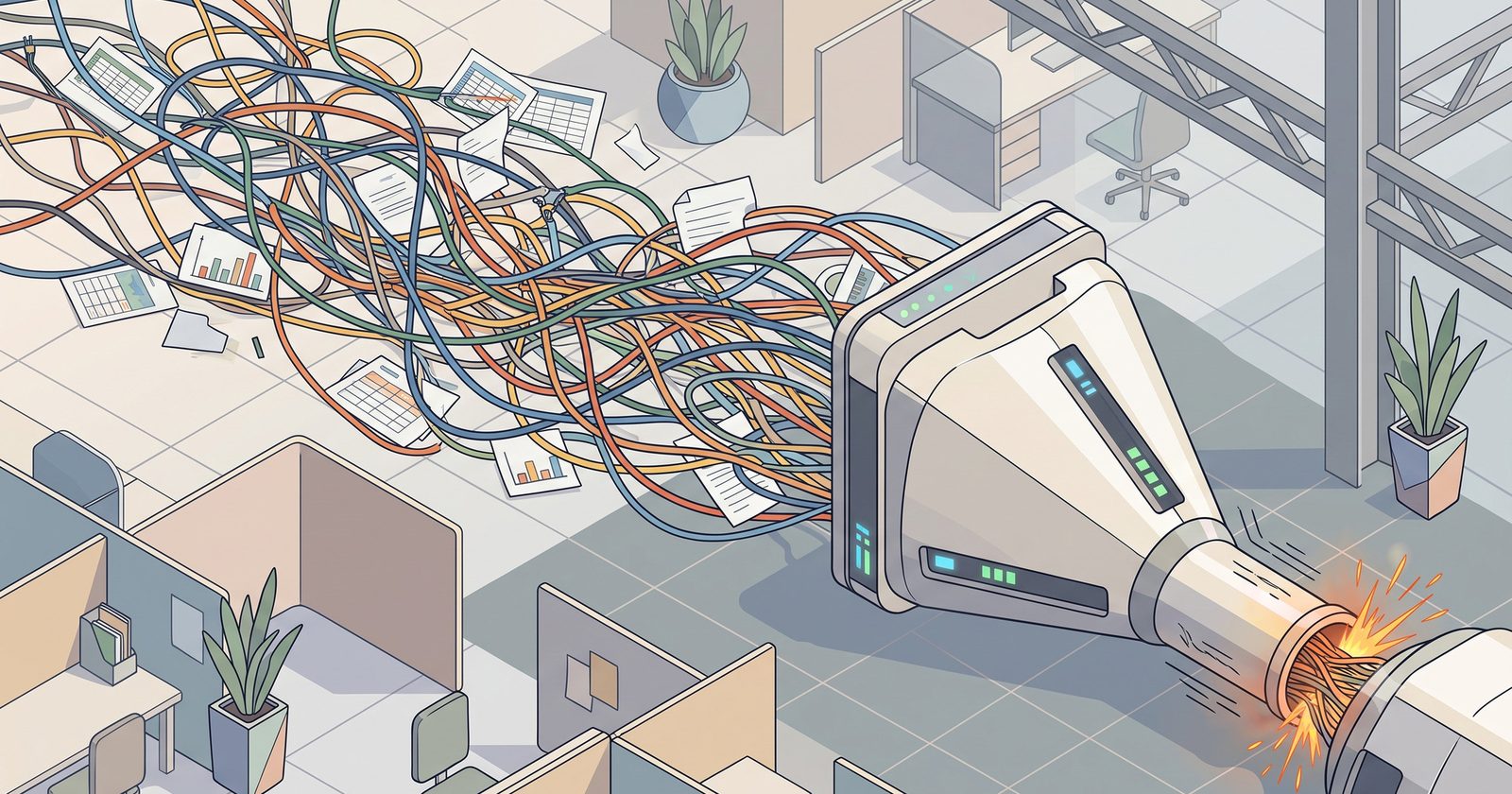
While industry talk keeps repeating that 2026 is the year agentic AI goes into production, a joint report by RMS and RoomPriceGenie — a survey of more than 170 hotel operators worldwide, published in April 2026 — finally puts numbers on why most of those projects stall before they even start. It isn't the technology. It's the state of the data that technology is supposed to read.
The four numbers that explain the bottleneck
The central finding is this: nearly 70% of operators rate the accuracy of their own data at 2 or 3 out of 5. That's not a minority with bad luck; it's the majority of the industry admitting, in its own voice, that it doesn't trust the information it handles every day.
The rest of the study's figures explain the concrete cost of that problem. 42% of operators lose between 1 and 3 hours a week fixing connection failures between systems — some go beyond 7 hours —: time staff lose acting as a bridge between programs that should talk to each other on their own. 25% of properties have no one responsible for connectivity between systems: no one whose job is, explicitly, to make sure the data lines up. And 83% of the professionals surveyed say their technology causes them operational stress.
The figure that should worry anyone planning their first AI project the most is this: even hotels with just one to three connected systems suffer incorrect rates and missing data. The problem isn't how many tools you use. It's how well they talk to each other.
Dirty data isn't always an error. Sometimes it's three correct figures that don't mean the same thing. Consultant Rafael del Castillo Ferreira explains this using RevPAR: within the same hotel group, the figure calculated by operations, the one used by the sales team and the one in the revenue management system all coexist. All three are valid; each treats out-of-order rooms, complimentary stays, house use or rebates paid later differently. If an AI receives all three without knowing which is which, it has no way to choose.
"You can't automate what you can't trust"
Hospitality Tech, the outlet that picked up the report, elevates it to a thesis: dirty data is the red flag that should stop any agentic AI deployment in 2026. An agent that books, prices or replies to a guest automatically doesn't fix the fragmentation of a poorly integrated stack — it amplifies it, because now a wrong decision gets made by a machine at full speed, without the pause for doubt a person would have.
It's exactly the same thesis that has been circulating in Spanish technical forums for months, though without figures to back it up until now. In a TecnoHotel piece on the agentic era, Javier de la Lastra (Mews) put it in a line worth remembering: if systems don't talk to each other, AI can't work. And he added the nuance that's hardest to accept: AI doesn't fix a business's inefficiencies, it amplifies them.
Named cases are starting to prove him right. At the Next Tourisme conference (Paris, June 4, 2026), according to Nicolas François's report, Club Med said its first AI use case — a copilot for its travel advisors — failed for lack of up-to-date data, and that it chose to stop everything and rebuild how it manages its data. At the same event, Best Western explained that it connected its AI only to its internal database, to stop it from inventing amenities such as a pool the hotel doesn't have. And the case that shows the cost of not doing this is Air Canada's: in February 2024, a British Columbia tribunal ordered it to pay a customer about 650 Canadian dollars, plus interest and fees, because its chatbot had promised him a bereavement discount that another page on the same website ruled out. The airline argued that the chatbot was responsible for its own actions; the tribunal replied that the company is responsible for everything its website says, no matter if the information sits on a fixed page or comes from a chatbot.
The four-step readiness checklist
Mews, in its late-2025 industry outlook report (a panel of 18 industry experts), proposes a readiness checklist that can be adapted almost line by line to a small Spanish business: first, map the entire stack and spot where the data silos are — and which providers are already building toward open APIs and which aren't; second, get your content "AI-ready," with a single source-of-truth listing and concise Q&As synced across every channel; third, launch a small, supervised pilot with metrics reviewed within weeks, not months; and fourth, set up internal governance — who decides, who trains the team, who's accountable if something breaks.
Wouter Geerts, Mews' head of research, frames it as a closing window: hotels that treat 2026 as a planning year will lose ground to those already cleaning up data, content and systems — because those will be the ones AI can find, trust, and end up sending business to. It's worth noting, though, that Mews, RMS and RoomPriceGenie all sell exactly the software that solves the problem they describe: their diagnosis is sincere, but it also suits them.
McKinsey confirms this isn't only a small-hotel problem
In case anyone thinks this is a problem exclusive to under-resourced small businesses, McKinsey adds the counterweight with the least suspect stamp of prestige available: in its reference report on agentic AI in travel, the consultancy warns that more than 70% of digital transformations lose momentum during the adoption and scaling phase — not at the announcement stage, nor during the press-friendly pilot, but exactly when the change has to be sustained day to day. According to McKinsey, the industry scores well on technology and poorly on what sustains it: talent, adoption and scaling.
What to do if you don't have consultancy budget
The good news is that fixing this doesn't require, to begin with, either a six-figure project or a data department. It requires one afternoon and discipline. Take five different room rates and compare them across your booking engine, your PMS and your two main sales channels: any discrepancy is already an identified leak. Export your contact list from your CRM and your email marketing tool and look for duplicates with mismatched details. And above all, answer an uncomfortable question out loud: who on your team is responsible for making these systems talk to each other? If the answer is "no one in particular," you've just found, like 25% of the hoteliers in this study, the real reason your next AI project risks failing before it starts.

